PNS vs TENS for Diabetic Neuropathy: How They Differ
In brief
Transcutaneous electrical nerve stimulation (TENS) is a surface-level therapy delivered through skin pads, while peripheral nerve stimulation (PNS) places a thin lead near a specific peripheral nerve in a clinician-performed procedure. This guide compares mechanism, placement, treatment schedule, insurance, and candidacy so you and your clinician can discuss which fits painful diabetic neuropathy.
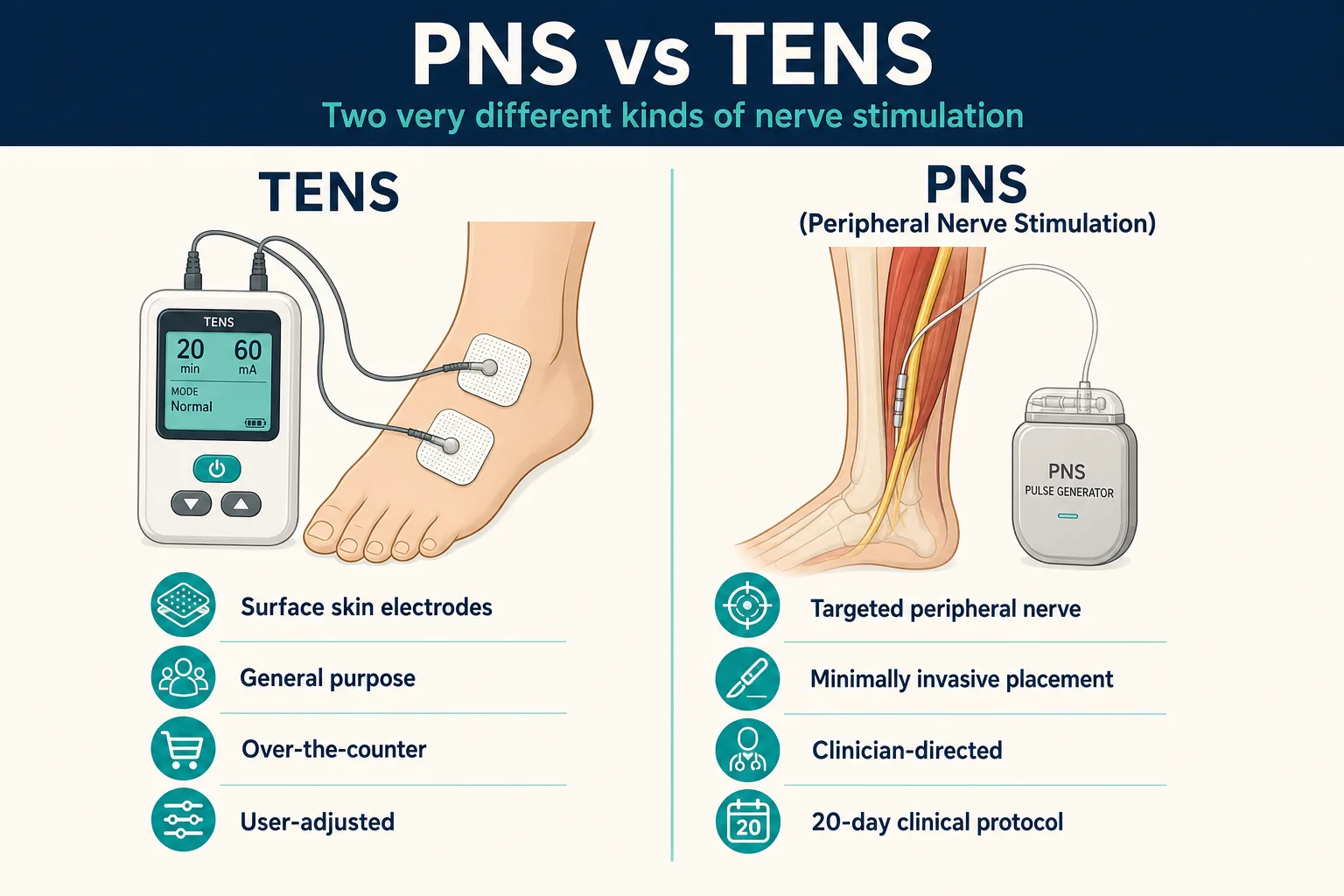
# PNS vs. TENS for Diabetic Neuropathy: How the Two Differ
If you have been searching for a "device for neuropathy" or comparing nerve stimulators to a TENS unit you can buy online, the underlying technologies are not the same. Both use electrical stimulation, but they target different nerves, use different hardware, and follow different treatment plans.
This guide explains the clinical differences between **TENS** (transcutaneous electrical nerve stimulation) and **PNS** (peripheral nerve stimulation), so you can have a more productive conversation with your clinician about chronic pain associated with painful diabetic neuropathy (PDN).
What TENS units do
A TENS unit is a small, battery-powered consumer device. Adhesive pads are placed on the skin over the painful area and deliver a low-voltage electrical current through the skin to nearby sensory nerves. TENS is generally available without a prescription and is used at home for short, on-demand sessions.
- **Where stimulation is delivered:** through the skin, to nearby sensory nerves.
- **Hardware:** external pads and a handheld controller, used at home.
- **Duration:** short sessions, used as needed. Response and duration vary; ask your clinician what evidence applies to the proposed device and your diagnosis.
- **Clinical role:** symptomatic relief; not a targeted treatment of a specific peripheral nerve.
TENS can be a reasonable adjunct for some patients. Because the current is delivered across the skin rather than at a specific nerve, it is not targeted at one peripheral nerve. Response and duration vary; ask your clinician what evidence applies to the proposed device and your diagnosis.
What peripheral nerve stimulation (PNS) does
Peripheral nerve stimulation places a thin lead near a **specific peripheral nerve** involved in the patient's pain. Which nerve is targeted, where the lead sits, and how the placement is performed differ from product to product. Placement is a clinician-performed procedure, so PNS is prescribed and supervised rather than self-directed.
- **Where stimulation is delivered:** directly to a targeted peripheral nerve, near the source of pain.
- **Hardware:** varies by product. Some systems use a temporary lead that is removed at the end of treatment; others are permanently implanted with a pulse generator.
- **Duration:** treatment schedule, electrode placement, removal and follow-up depend on the specific device and prescription; the treating clinician should explain the current device labeling and care plan.
- **Clinical role:** a non-opioid, non-pharmacologic option for patients whose chronic PDN pain has not responded adequately to first-line medications.
Because the stimulation is delivered through a lead placed near the nerve itself, PNS does not depend on the current crossing the skin and surrounding tissue to reach its target. Regulatory clearance applies to a named product with its own labeling, not to nerve stimulation as a category, and published results for one system do not automatically apply to another.
Side-by-side
| Attribute | TENS unit | Peripheral nerve stimulation | | --- | --- | --- | | Prescription required | Usually no | Yes, placed by a trained clinician | | Where stimulation reaches the nerve | Through the skin | At a targeted peripheral nerve | | Hardware | External pads, handheld unit | A lead placed near the nerve; temporary or implanted depending on the product | | Treatment schedule | Short, on-demand sessions | Set by the specific device labeling and the clinician's prescription | | FDA status for chronic PDN | General OTC pain device | Specific products are FDA-cleared; clearance is product-specific | | Typical setting | Home | In-office or procedural placement, with clinical follow-up |
This comparison is educational and explains how the two options differ. It is not a claim of superiority, and neither option repairs nerve damage or treats diabetes itself. Your clinician will decide what is appropriate for your specific situation.
When a clinician might consider PNS
First-line treatments for PDN typically include glycemic optimization, lifestyle measures, and medications such as duloxetine, pregabalin, or gabapentin. When these are not sufficient — or when side effects make them difficult to tolerate — clinicians may consider non-pharmacologic options.
A temporary, minimally invasive PNS approach can be a reasonable next step to discuss before considering a permanently implanted system. Any procedure carries risks, including infection, bleeding, discomfort, lead movement, or the treatment not providing enough relief, and these should be discussed alongside the potential benefit.
Frequently asked questions
**Is peripheral nerve stimulation just a fancy TENS unit?** No. TENS delivers current through the skin; PNS delivers stimulation through a lead placed near a specific peripheral nerve, under clinical supervision.
**Can I try TENS first and then PNS?** Many patients have used TENS before being evaluated for PNS. Your clinician can advise on sequencing based on your pain pattern and prior treatment history.
**Is peripheral nerve stimulation always a permanent implant?** No. Some systems use a temporary lead that the clinician removes at the end of the prescribed treatment period; others are permanently implanted. Ask which type a specific product is.
**What happens when the prescribed treatment period ends?** The treating clinic explains device removal where applicable, follow-up and next steps for the specific treatment.
**Is it covered by insurance?** Coverage is payer-, plan- and product-specific and is not guaranteed. Verify benefits directly with your plan for the specific product proposed. See our [insurance coverage page](/insurance-coverage) for how benefits verification and prior authorization typically work.
Next steps
- See whether a temporary PNS approach may fit your situation: [Am I a candidate?](/am-i-a-candidate)
- Compare other options: [PNS vs. SCS](/compare/pns-vs-scs) and [Temporary vs. permanent neuromodulation](/compare/temporary-vs-permanent)
PNS vs TENS at a glance
| Attribute | Peripheral nerve stimulation (PNS) | TENS unit |
|---|---|---|
| Mechanism | Targeted electrical stimulation of a peripheral nerve implicated in the pain pathway; which nerve is targeted depends on the product and the prescription. | Broad transcutaneous current delivered across skin, modulating pain signaling non-selectively. |
| Placement | A thin lead placed by a trained clinician during a procedure. The target nerve, lead position and technique differ between products. | Adhesive surface electrodes applied by the patient to the skin over the painful area. |
| Treatment schedule | Treatment schedule, electrode placement, removal and follow-up depend on the specific device and prescription; the treating clinician should explain the current device labeling and care plan. | Used on-demand by the patient for symptomatic relief; no defined therapeutic course. |
| Duration of relief | Response and duration vary; ask your clinician what evidence applies to the proposed device and your diagnosis. | Response and duration vary; ask your clinician what evidence applies to the proposed device and your diagnosis. |
| Insurance | Coverage is payer-, plan- and product-specific and is not guaranteed; verify benefits with the plan for the specific product. | Coverage is payer-, plan- and product-specific and is not guaranteed; verify benefits with the plan for the specific product. |
| Candidacy | Adults with chronic pain associated with painful diabetic neuropathy who have not had adequate relief from first-line therapy; determined by a clinician. | Adults seeking non-invasive, self-directed symptom relief; not a substitute for clinical management. |
Educational comparison; not a claim of superiority. Individual clinical decisions should be made with a qualified clinician.
Non-invasive, minimally invasive and implanted devices
Devices used for nerve pain are often grouped together as "neuropathy devices," but they differ in how far into the body they go, who places them, and what happens afterwards. None of these categories repairs damaged nerves or treats diabetes itself, and no category is automatically newer or better than another. The right comparison is between two specific products a clinician has actually proposed for your situation.
Non-invasive: surface electrodes worn on the skin
TENS units and similar surface-electrode devices sit outside the body. Adhesive pads carry current through the skin toward nearby sensory nerves. Many are available without a prescription and are used at home in short sessions.
Limitations and risks: Nothing enters the body, so procedural risk is low; skin irritation under the pads is the most common complaint. Relief is usually limited to the time the unit is running, and these devices are not a treatment for the underlying nerve damage or diabetes.
Minimally invasive: a clinician-placed lead, later removed
In procedure-based peripheral nerve stimulation, a clinician places a thin lead near a targeted nerve so stimulation does not have to cross the skin. The lead is removed at the end of the prescribed treatment period and no pulse generator is left behind.
Limitations and risks: Because the skin is broken, there is some risk of infection, bleeding, discomfort, lead migration, or the device not helping. Treatment schedule, electrode placement, removal and follow-up depend on the specific device and prescription; the treating clinician should explain the current device labeling and care plan.
Implanted: permanent hardware
Spinal cord stimulators and permanently implanted peripheral systems involve surgically placed leads and an implanted pulse generator intended to stay in the body long term.
Limitations and risks: These involve surgery, device programming visits, battery or generator management, possible revision or explant procedures, and considerations for future imaging such as MRI. Candidacy is normally assessed after other options have been tried.
Questions to ask before agreeing to a device
- Which category does this device fall into — surface electrodes, a procedure with a lead that is later removed, or permanent implanted hardware?
- What does the current labeling say this specific device is cleared or approved for, and does that match my diagnosis?
- How long is the prescribed treatment, who removes anything that was placed, and what does follow-up look like?
- What are the realistic limits — what share of people get meaningful relief, and what happens if I am not one of them?
- What are the risks for me specifically, given my blood sugar control, circulation, skin condition, infection history, and any implanted devices such as a pacemaker?
- What will this cost after insurance, and what is the plan if prior authorization is denied?
- How does this fit with the rest of my care — medications, physical therapy, foot checks, and diabetes management?
Related reading
Frequently asked questions
- Is PNS the same as a TENS unit?
- No. Transcutaneous electrical nerve stimulation (TENS) delivers current through surface electrodes placed on the skin over a broad area. Peripheral nerve stimulation (PNS) places a thin lead near a specific peripheral nerve in a clinician-performed procedure, so stimulation is targeted and the treatment is prescribed and supervised rather than self-directed. Response and duration vary; ask your clinician what evidence applies to the proposed device and your diagnosis.
- Does insurance cover PNS for diabetic neuropathy?
- Coverage is payer-, plan- and product-specific and is not guaranteed. Verify benefits directly with the plan for the specific product, and ask the clinic whether prior authorization and supporting documentation are required. See our insurance coverage page for how benefits verification usually works.
- What happens when the prescribed treatment period ends?
- The treating clinic explains device removal where applicable, follow-up and next steps for the specific treatment. Treatment schedule, electrode placement, removal and follow-up depend on the specific device and prescription, and published results from one system do not automatically apply to another. Neither TENS nor PNS repairs nerve damage or treats the underlying diabetes, so ongoing medical management and foot care continue either way.
- Is a lead placed under the skin the same as a permanent implant?
- Not necessarily. Nerve-stimulation devices fall into different categories: surface-electrode devices worn on the skin, procedure-based systems in which a clinician places a temporary lead that is later removed, and permanently implanted systems with hardware such as a pulse generator that stays in the body. Hardware, treatment length, risks and follow-up differ between products within each category, so ask the treating clinician which category a specific device belongs to and what its current labeling says.
A board-certified pain medicine physician (MD) on the NeuroDynamics Global Medical Affairs team reviewed this article as it stood in July 2026. That review covers only the material as written at that time. The September 2026 revisions — the device-category overview, the questions-to-ask list, and the edits to the comparison table and FAQs — are general educational information and have not been medically reviewed.
Important medical disclaimer. This content is for general informational and educational purposes only and is not medical advice, diagnosis, or treatment. It does not establish a physician–patient relationship. Always consult a qualified healthcare provider before starting, stopping, or changing any medication or therapy.
About device options. Device options differ in indications, placement, risks and treatment schedule. Ask the treating clinician to identify the specific device, its current labeling, evidence relevant to your diagnosis and follow-up plan.
Results vary. Individual results and experiences vary from patient to patient. No specific outcome is guaranteed. Coverage and reimbursement are payer- and plan-specific.
Want to learn more?
Talk to your healthcare provider or contact NeuroDynamics Global today.