Beyond Gabapentin: Drug-Free Options for Diabetic Neuropathy Relief
In brief
Gabapentin is a common first-line oral medication for painful diabetic neuropathy, but many patients don't get adequate relief or can't tolerate the side effects. Here's a plain-language look at drug-free options — including the FDA-cleared NS100 by NeuroDynamics Global.
Many people living with painful diabetic neuropathy (PDN) are first prescribed gabapentin (Neurontin) or pregabalin (Lyrica). These oral medications help some patients, but a meaningful share either don''t get the relief they hoped for or struggle with side effects such as drowsiness, dizziness, swelling, weight gain, or brain fog. If that sounds familiar, you may be wondering what drug-free options exist.
This article gives a plain-language overview of non-pharmacologic approaches to diabetic nerve pain, and explains how the NS100 by NeuroDynamics Global — an FDA-cleared, non-opioid, 20-day neuromodulation therapy — fits into the conversation. It is educational only and is not medical advice. Any change to your medications or treatment plan should be made with the provider who prescribed them.
Why patients look beyond gabapentin
Gabapentin and pregabalin work by calming overactive nerve signaling. They can help, but they don''t work for everyone, and side effects are a common reason patients stop taking them. Other oral options — duloxetine, tricyclic antidepressants, and opioids — also carry trade-offs ranging from systemic side effects to dependence risk.
When first-line medications don''t deliver adequate, durable relief, many patients and providers consider non-drug therapies that work locally on the nerves rather than systemically through the bloodstream.
Lifestyle foundations that support nerve health
Before or alongside any therapy, the basics still matter:
- **Glycemic control.** Stable blood sugar is one of the most important long-term levers for nerve health.
- **Foot care.** Daily inspection, well-fitted shoes, and prompt attention to wounds reduce complications.
- **Physical activity.** Regular, provider-approved movement supports circulation and overall nerve function.
- **Sleep and stress.** Both directly influence how the nervous system experiences pain.
These are not a substitute for treatment of established nerve pain, but they form the foundation that every other option builds on.
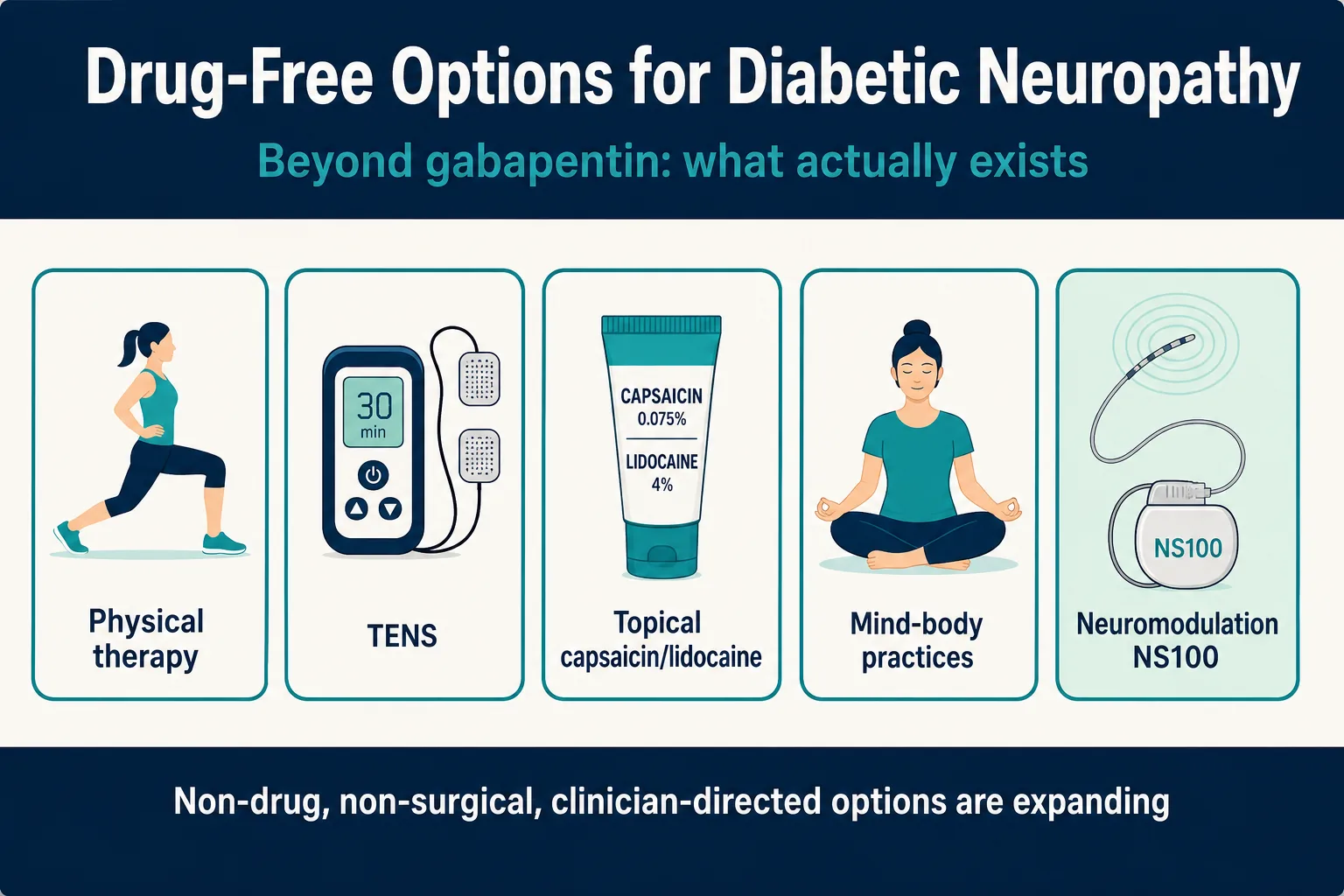
Non-drug therapies patients commonly explore
- **Physical therapy and graded exercise programs** focused on balance, strength, and circulation.
- **Topical treatments** applied to the skin (your provider can advise on what is appropriate for you).
- **TENS units** — over-the-counter transcutaneous electrical stimulation that some patients use for short-term symptom relief.
- **Acupuncture and mind–body approaches**, used by some patients as complementary support.
- **Peripheral nerve stimulation (PNS)** — a medical, device-based therapy that delivers gentle electrical pulses directly to the peripheral nerves involved in your pain.
PNS is where NS100 fits.
Where NS100 by NeuroDynamics Global fits
NS100 is an FDA-cleared Class II peripheral nerve stimulation system for chronic pain associated with painful diabetic neuropathy. Unlike an oral medication, it is non-pharmacologic — there is no daily pill, no systemic drug exposure, and no opioid involvement.
Key characteristics:
- **20-day temporary therapy.** A defined, time-limited course — worn for 20 days, then the leads are removed by your provider in a simple in-office visit. Nothing is left in the body.
- **Minimally invasive in-office placement** under topical anesthesia.
- **Non-opioid, non-pharmacologic.** Targets nerves directly rather than working through the bloodstream.
- **Established Medicare reimbursement pathways** for eligible patients; coverage is payer- and plan-specific.
Eligibility, expected outcomes, and whether NS100 is appropriate for you are determined by your treating provider. Individual results vary, and NS100 is not the right fit for every patient.
How NS100 compares with common oral options
Compared with gabapentin and pregabalin, NS100 avoids the sedation, dizziness, swelling, and weight gain that often lead patients to stop those medications. Compared with duloxetine or tricyclic antidepressants, it avoids systemic antidepressant exposure. Compared with opioids, it carries no risk of opioid dependence.
This is not a claim that NS100 is better than any specific medication for any specific person — it is a different category of therapy with a different risk and side-effect profile. The right choice depends on your medical history, what you have already tried, and your goals.
Questions to ask your provider
If you are considering moving beyond gabapentin, useful questions include:
- Given what I''ve already tried, is a non-pharmacologic therapy a reasonable next step for me?
- Am I a candidate for peripheral nerve stimulation, and specifically for NS100?
- What does the 20-day NS100 protocol look like in your practice?
- What coverage options apply to me through Medicare or my insurance?
- What outcomes have your other PDN patients experienced?
Learn more
If you''d like to dig deeper into specific topics, see:
- [Gabapentin Alternatives for Diabetic Neuropathy](/gabapentin-alternatives)
- [Non-Opioid Neuropathy Treatment](/non-opioid-neuropathy-treatment)
- [Painful Diabetic Neuropathy](/painful-diabetic-neuropathy)
- [Am I a Candidate?](/am-i-a-candidate)
- [Insurance Coverage](/insurance-coverage)
**Disclaimer:** This article is for informational purposes only and does not constitute medical advice. It does not promise any specific outcome. Always consult a qualified healthcare provider before changing medications or starting a new therapy. Individual results vary.
Important medical disclaimer. This content is for general informational and educational purposes only and is not medical advice, diagnosis, or treatment. It does not establish a physician–patient relationship. Always consult a qualified healthcare provider before starting, stopping, or changing any medication or therapy.
About NS100 by NeuroDynamics Global. NS100 is an FDA-cleared Class II peripheral nerve stimulation medical device for chronic pain associated with painful diabetic neuropathy. Use of NS100 requires evaluation and prescription by a qualified healthcare provider. As with any medical device, NS100 carries potential risks; your provider will review indications, contraindications, and possible side effects with you.
Results vary. Individual results and experiences vary from patient to patient. No specific outcome is guaranteed. Coverage and reimbursement are payer- and plan-specific.
Want to learn more?
Talk to your healthcare provider or contact NeuroDynamics Global today.