What Is Painful Diabetic Neuropathy? A Complete Guide for Patients
In brief
Living with diabetes and unexplained foot pain? Learn what painful diabetic neuropathy (PDN) is, its symptoms, how it's diagnosed, and the full range of modern treatment options.
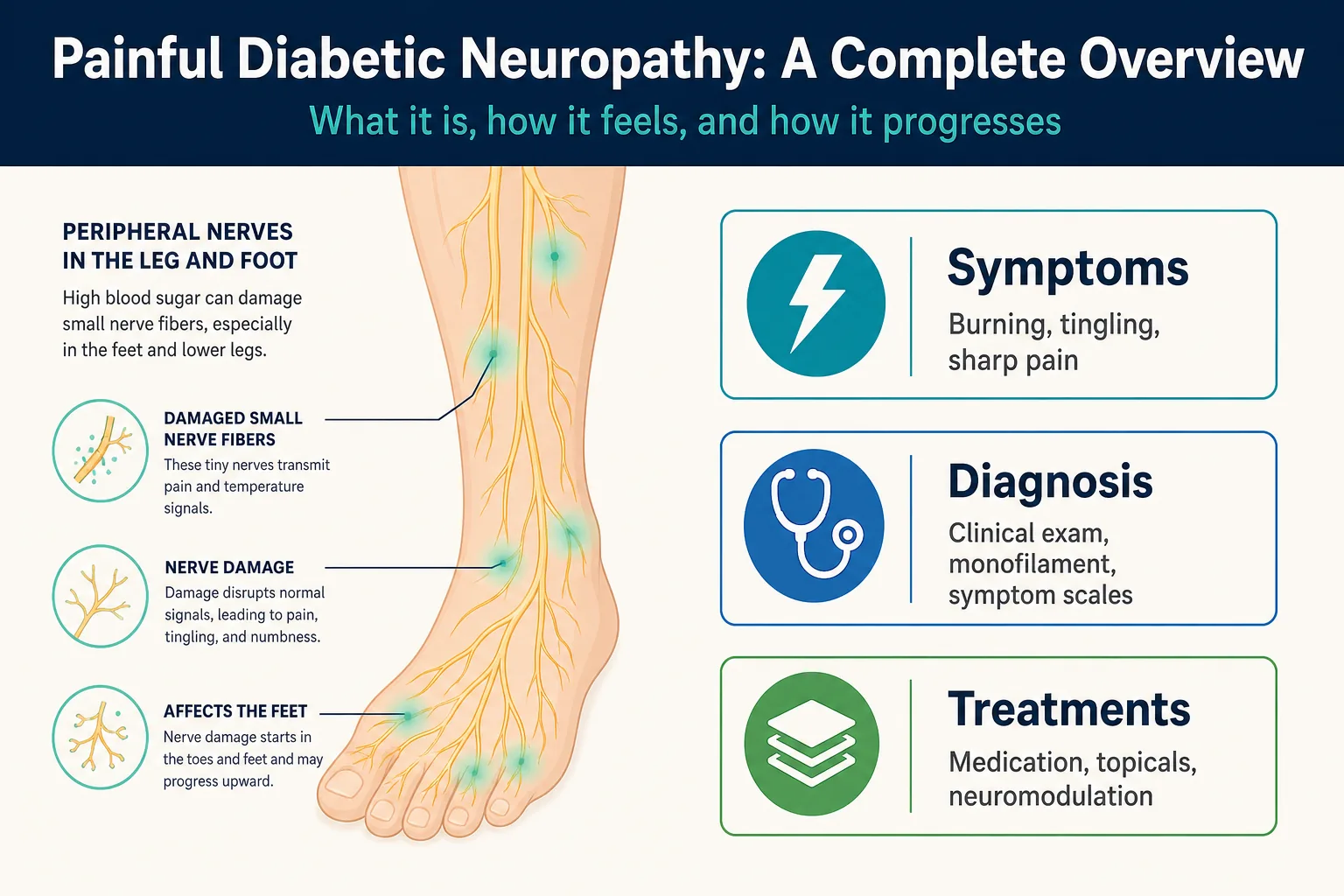
Living with diabetes means managing many aspects of your health, from blood sugar levels to diet and exercise. For many, an unexpected and challenging complication can arise: chronic pain, tingling, or numbness in the feet and hands. This condition is known as painful diabetic neuropathy, or PDN. It can be confusing and frustrating, often disrupting sleep, work, and daily life.
If you are experiencing these symptoms, you are not alone. Understanding what is happening in your body is the first step toward finding effective relief. This guide is designed to walk you through the essentials of painful diabetic neuropathy, from what it is and how it is diagnosed to the full landscape of treatment options available today.
What Is Diabetic Neuropathy?
To understand painful diabetic neuropathy, we first need to look at neuropathy itself. The word neuropathy simply means nerve damage. Your body's nervous system is like a complex electrical network, sending signals between your brain, spinal cord, and the rest of your body. These signals control everything from your muscles to your sense of touch, temperature, and pain.
Diabetes can interfere with this system. Consistently high levels of blood sugar over a long period can be toxic to nerves. This sugar damages the small blood vessels that supply nerves with the oxygen and nutrients they need to function. It can also harm the protective coating around nerves, called the myelin sheath. When nerves become damaged, they can no longer send signals correctly. They might send faulty pain signals when there is no cause for pain, send signals too slowly, or stop sending signals altogether.
There are several types of diabetic neuropathy, but the most common is peripheral neuropathy. This affects the nerves outside of the brain and spinal cord, most often in the feet and legs, and sometimes in the hands and arms. When this peripheral neuropathy causes symptoms of pain, it is called painful diabetic neuropathy (PDN).
Common Symptoms of Painful Diabetic Neuropathy
The experience of PDN can vary widely from person to person. The sensations can range from mildly annoying to completely debilitating. A key feature is that these symptoms are often worse at night, which can severely impact sleep and overall quality of life.
Common symptoms include:
- Burning Pain: Many people describe a constant, smoldering, or burning sensation, typically in the feet. It can feel like your feet are on fire or submerged in hot water.
- Tingling or Pins and Needles: This sensation, medically known as paresthesia, is a very common complaint. It can feel like your foot or hand has fallen asleep, but the feeling does not go away.
- Sharp, Stabbing, or Shooting Pains: Some individuals experience sudden, sharp, jabbing pains that feel like an electric shock. These can occur without any warning and can be extremely intense.
- Extreme Sensitivity to Touch: A condition called allodynia can develop, where even light touch causes significant pain. The gentle pressure of a bedsheet or wearing socks can become unbearable.
- Numbness: This is the flip side of the pain. As nerves become more damaged, they may stop sending signals entirely, leading to a loss of sensation. This is particularly dangerous because you may not feel cuts, blisters, or sores on your feet, which can lead to serious infections.
It is common for a person to experience both pain and numbness at the same time, which can be a confusing and distressing combination.
How Is Painful Diabetic Neuropathy Diagnosed?
If you report symptoms of PDN to your healthcare provider, they will likely follow a structured process to confirm the diagnosis and rule out other potential causes of your nerve pain.
Medical History and Symptom Review
The first step is a detailed conversation. Your provider will ask you to describe your symptoms: what they feel like, where they are located, when they started, and what makes them better or worse. They will also review your history with diabetes, including how long you have had it and your typical blood sugar control.
Physical Examination
Your provider will perform a physical exam, focusing on your feet and legs. This often includes a few simple, painless tests to check your nerve function:
- Monofilament Test: Your provider will use a soft nylon fiber, called a monofilament, to touch various spots on the bottom of your feet. This tests your ability to feel light pressure. If you cannot feel the fiber, it indicates a loss of protective sensation.
- Vibration and Temperature Sensing: Your provider may use a tuning fork or other specialized instruments to see if you can feel vibrations or changes in temperature against your skin.
- Reflex Checks: Testing your ankle reflexes can also give clues about nerve health.
Advanced Nerve Tests
In some cases, your provider may recommend more specialized tests to get a clearer picture of the nerve damage:
- Nerve Conduction Studies (NCS): This test measures how quickly and strongly electrical signals travel through your nerves. Small electrodes are placed on your skin over a nerve, and a mild electrical pulse is delivered to stimulate the nerve. Other electrodes record the response, showing if the signal is delayed or weakened.
- Quantitative Sensory Testing (QST): This is a more detailed way to measure how your nerves respond to stimuli like vibration, cold, and heat. It can help quantify the extent of sensory loss or hypersensitivity.
These tests help confirm the presence of neuropathy and can help track its progression over time.
The Progression and Impact on Quality of Life
Without proper management, PDN can progress. Symptoms that begin in the toes can gradually spread up the feet and into the legs. This is sometimes called a stocking distribution. If it affects the hands, it can spread up the arms in a glove distribution.
This progression has a profound impact on a person's quality of life. The constant pain can make walking difficult and exercise painful, which can unfortunately make blood sugar control even harder. Fear of sudden, stabbing pains can cause anxiety, while the chronic nature of the condition can lead to feelings of depression and hopelessness.
Loss of sleep due to nighttime pain is one of the most common complaints, leading to daytime fatigue, irritability, and difficulty concentrating. The loss of sensation also brings its own dangers. Not being able to feel a small rock in your shoe can lead to a blister, which can become an ulcer. For people with diabetes, these foot ulcers can be very slow to heal and are a leading cause of serious infections and, in worst-case scenarios, amputation.
The Landscape of Treatments for PDN
While there is no cure for the nerve damage itself, there are many ways to manage the painful symptoms of PDN and improve your quality of life. Treatment is a partnership between you and your healthcare team, and it often involves a combination of approaches.
Foundation of Care: Blood Sugar Control
The most important step in managing any diabetes complication is to manage your blood sugar. While tight glucose control may not reverse existing nerve damage, it is the best way to prevent the neuropathy from getting worse. This involves working closely with your healthcare provider to follow your recommended diet, exercise, and medication plan.
Oral Medications
For many years, oral medications have been the first line of defense for managing the pain of PDN. These drugs do not fix the nerve damage, but they can help calm the overactive pain signals.
- Anticonvulsants: Medications like pregabalin and gabapentin are commonly prescribed. They were originally developed to treat seizures but were found to be effective at reducing nerve pain by calming hyper-excitable nerves.
- Antidepressants: Certain types of antidepressants, particularly serotonin and norepinephrine reuptake inhibitors (SNRIs) like duloxetine, can also be effective for nerve pain. They work by changing the levels of chemical messengers in the brain that are involved in processing pain signals.
These medications can be very helpful for some people, but they do not work for everyone and can come with side effects such as dizziness, drowsiness, and weight gain. Finding the right medication and dosage can take time and patience.
Topical Treatments
For pain that is localized to a specific area, topical treatments applied directly to the skin can provide relief. These can come in the form of creams, gels, or patches. They contain ingredients that can numb the area or reduce the transmission of pain signals from the skin nerve endings. They have the advantage of having fewer widespread side effects than oral medications.
Device-Based Nerve Stimulation
When traditional medications and therapies are not providing enough relief, it may be time to consider other advanced options. One such approach is neuromodulation, which involves using electrical stimulation to change how nerves transmit pain signals to the brain.
Device options differ in indications, placement, risks and treatment schedule. Ask the treating clinician to identify the specific device, its current labeling, evidence relevant to your diagnosis and follow-up plan. Regulatory clearance applies to a named product with specific labeling, not to nerve stimulation as a category, and results published for one system do not transfer to another.
Broadly, these devices fall into three groups: surface electrodes worn on the skin, a procedure in which a clinician places a thin lead near a nerve and removes it at the end of a prescribed treatment period, and permanently implanted hardware. The aim of stimulation is to change how nerves signal pain; it does not repair nerve damage or treat diabetes itself. Which nerve is targeted, how the device is placed, how long treatment lasts and what follow-up involves differ from product to product.
Ask what published evidence exists for the specific product being proposed and in which patients it was studied, along with the risks — including infection, bleeding, discomfort, movement of a placed lead, or not getting enough relief — and the follow-up plan. Individual results vary and no specific outcome is guaranteed.
When to Talk to Your Doctor
It is essential to maintain an open dialogue with your healthcare provider about your pain. You should schedule a visit if:
- Your pain is new or has changed in character.
- Your current treatment plan is no longer effective.
- The side effects of your medication are interfering with your life.
- Your pain is making it difficult to sleep, work, or enjoy your daily activities.
- You notice any new sores, blisters, or cuts on your feet that are not healing.
Painful diabetic neuropathy is a serious medical condition. With an accurate diagnosis and a comprehensive treatment plan, many people see meaningful improvement in their symptoms, though results vary from person to person and no plan works for everyone. It is important to be an active participant in your own care, learning about your condition and exploring all available options.
If you are living with the daily challenges of painful diabetic neuropathy, talk to your healthcare provider to explore a treatment plan that is right for you. You can also contact NeuroDynamics Global with general questions about peripheral nerve stimulation.
Treatment options: three different jobs
It helps to separate what each part of a care plan is actually for. Treating the underlying condition, protecting the feet, and easing the pain are related but distinct, and something that helps with one does not necessarily help with the others.
Treating the underlying condition
Blood glucose management, blood pressure and lipid control, activity, and reviewing medicines or other causes of neuropathy with your clinician. This aims at the disease process behind the nerve damage rather than at today's pain, and it is the part of care that can influence whether symptoms get worse over time.
Protecting the feet
Daily foot checks, well-fitting footwear, prompt attention to cuts, blisters, or colour and temperature changes, and regular professional foot exams. Reduced sensation means an injury can go unnoticed, so foot care runs alongside pain treatment for its own reasons — it is not a pain therapy.
Managing the pain and its knock-on effects
Medications, topical treatments, physical therapy, sleep and mood support, and in some cases device-based nerve stimulation. These target symptoms. They do not repair nerves, reverse neuropathy, or replace the two layers above.
Where devices fit, and what they do not do
Device-based nerve stimulation is usually discussed after medications and other measures have been tried and have not given enough relief. Devices differ in how far into the body they go: some use surface electrodes on the skin, some involve a procedure in which a clinician places a lead that is removed later, and some are permanently implanted. Risks, follow-up and cost differ accordingly, and results published for one product do not carry over to another.
Regulatory clearance applies to a named product with specific labeling, not to "nerve stimulation" as a category. Treatment schedule, electrode placement, removal and follow-up depend on the specific device and prescription; the treating clinician should explain the current device labeling and care plan. No device on the market repairs damaged nerves, and none can guarantee relief — published studies describe results in groups of patients, and individual response varies.
The comparison of surface-electrode TENS and clinician-placed peripheral nerve stimulation goes through those categories in more detail, including the questions worth asking before agreeing to any device.
Questions to bring to your appointment
- Has anything other than diabetes been ruled out as a cause of my nerve symptoms?
- What is my plan aimed at right now — slowing the damage, protecting my feet, easing the pain, or all three?
- How will we know whether a treatment is working, and when would we change course?
- What are the side effects or risks of this option for me, and what are the alternatives?
- If a device is suggested: which product is it, what is it cleared for, who places and removes it, and what happens afterwards?
- How often should my feet be examined, and what changes should prompt me to call?
Frequently asked questions
- Is there a treatment that fixes diabetic nerve damage?
- No treatment currently on the market is shown to repair nerve damage already caused by diabetes. Care has two separate jobs: slowing further damage by managing diabetes and the other factors behind it, and reducing the pain and the sleep, mood and mobility problems that come with it. Be cautious with any product that promises a cure, nerve regrowth, or guaranteed relief.
- Which clinician should treat painful diabetic neuropathy?
- Most people start with the clinician who manages their diabetes, who can confirm the diagnosis, check for other causes of neuropathy, and begin symptom treatment. Depending on what is found, that clinician may involve a neurologist, a pain medicine specialist, a podiatrist or foot-care team, or an endocrinologist. When a device or procedure is being considered, it is reasonable to ask how often the clinician performs it, what their complication rate is, and to seek a second opinion before agreeing.
- How do I compare device options for neuropathy pain?
- Ask which category the device belongs to — surface electrodes worn on the skin, a procedure in which a clinician places a lead that is later removed, or permanently implanted hardware — and what its current labeling says it is cleared or approved for. Clearance applies to a specific product, not to a whole category, and treatment schedule, placement, removal and follow-up depend on the specific device and prescription. Ask what happens if it does not help, what it costs after insurance, and how it fits with the rest of your care.
Sources
- NIDDK — What is diabetic neuropathy?
- NIDDK — Diabetes and foot problems
- NINDS — Peripheral neuropathy
- American Diabetes Association, Standards of Care in Diabetes 2026 — Retinopathy, Neuropathy, and Foot Care
This section, and the September 2026 edits elsewhere in this guide, are general patient education. They have not been through medical review and are not a substitute for advice from your own clinician.
Important medical disclaimer. This content is for general informational and educational purposes only and is not medical advice, diagnosis, or treatment. It does not establish a physician–patient relationship. Always consult a qualified healthcare provider before starting, stopping, or changing any medication or therapy.
About device options. Device options differ in indications, placement, risks and treatment schedule. Ask the treating clinician to identify the specific device, its current labeling, evidence relevant to your diagnosis and follow-up plan.
Results vary. Individual results and experiences vary from patient to patient. No specific outcome is guaranteed. Coverage and reimbursement are payer- and plan-specific.
Want to learn more?
Talk to your healthcare provider or contact NeuroDynamics Global today.