TENS Units and Diabetic Neuropathy: What They Do, Their Limits, and When to Consider Medical Neuromodulation
In brief
A straight answer on whether a TENS unit can help diabetic nerve pain — what the device actually does, where the evidence stops, and when a physician-directed option may fit better.
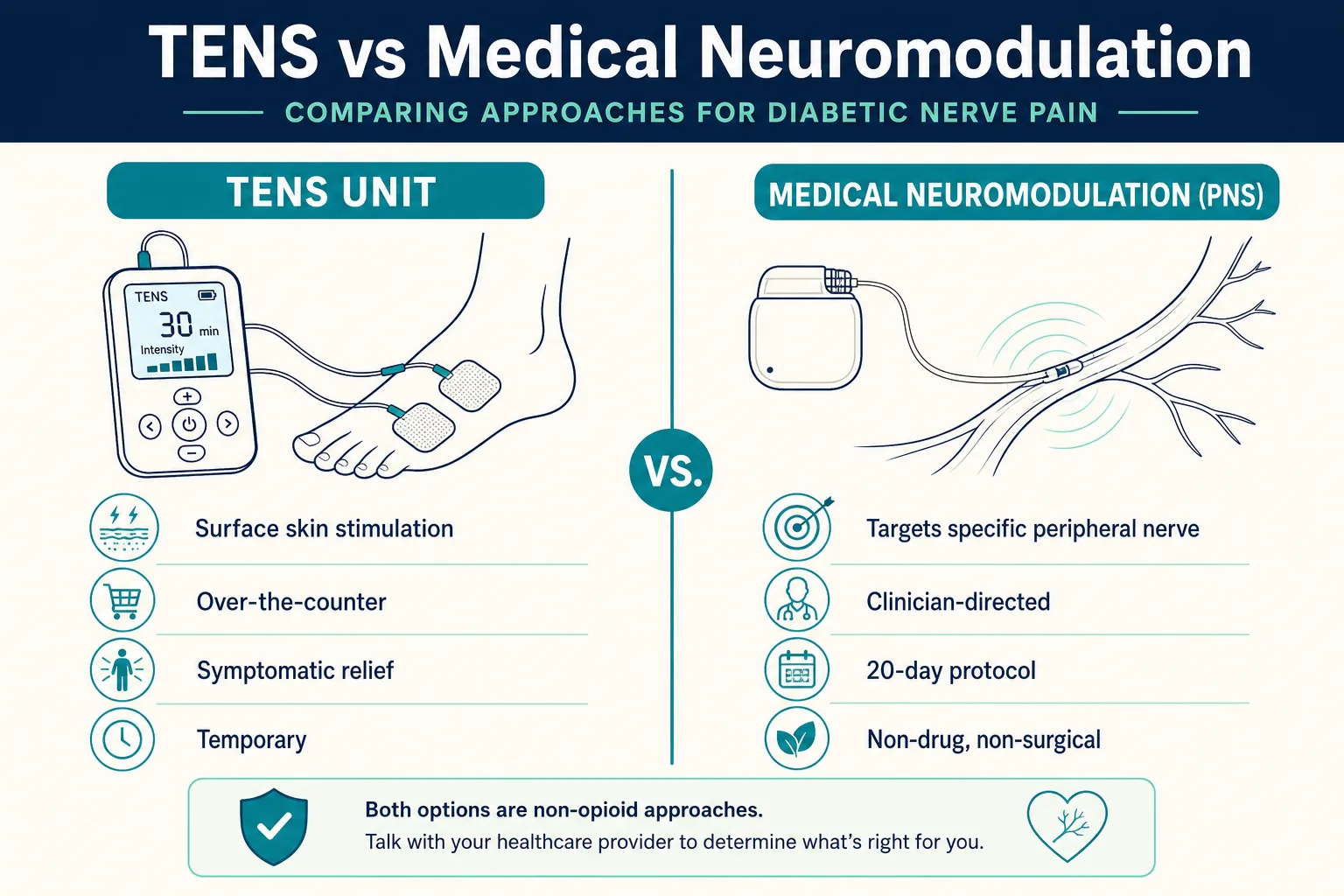
If you live with painful diabetic neuropathy, chances are you have searched whether a TENS unit — one of those small battery-powered devices with sticky pads you place on the skin — can help with burning, tingling, or shooting pain in your feet. This article gives you a straight answer: what a TENS unit actually does, what it does not do, and when it may be worth talking to your provider about a medical-grade neuromodulation option instead. It is educational only and is not medical advice.
What a TENS unit actually does
TENS stands for transcutaneous electrical nerve stimulation. A TENS unit delivers mild electrical pulses through surface pads (electrodes) placed on the skin. The most widely accepted explanation for how it helps is the 'gate-control' theory of pain: the electrical signals travel along large sensory nerve fibers and can, in effect, crowd out or dampen the pain signals traveling along smaller fibers toward the brain. Some people also report a release of the body's own pain-relieving chemicals with regular use.
In practical terms, TENS is a drug-free, at-home tool that some people use for short-term, symptomatic relief of pain — including some people with diabetic nerve pain. It is not a pill, not a surgery, and does not require a prescription for over-the-counter units.
Related reading: Non-drug and non-opioid options for nerve pain — /gabapentin-alternatives.
Where the evidence and the relief stops
This is where honesty matters. Any relief a TENS unit provides is symptomatic and temporary. It can quiet the sensation of pain while (and shortly after) it is being used, but it does not treat the underlying nerve dysfunction that drives painful diabetic neuropathy. When the device is switched off, the underlying condition is unchanged.
The published evidence for TENS specifically in diabetic peripheral neuropathy is mixed. Some studies and reviews suggest modest short-term benefit for some patients; others do not show a clear effect, and study quality varies. Over-the-counter TENS units are general-purpose consumer devices — they are not designed, tested, or FDA-cleared as disease-specific therapy for painful diabetic neuropathy.
There are also practical cautions. People with diabetic neuropathy often have reduced sensation in the feet, which makes it harder to feel skin irritation, burns from pads or gels, or stimulation that is too strong. TENS is generally not recommended over broken skin, active foot ulcers, or numb areas without provider guidance, and there are additional cautions for people with pacemakers or other implanted electronic devices. Before trying a TENS unit for diabetic nerve pain, talk to your healthcare provider about whether it is appropriate for your situation and how to use it safely.
TENS versus medical neuromodulation
TENS is one form of electrical stimulation, but it sits at the consumer end of a much broader family of therapies called neuromodulation — techniques that use targeted electrical signals to change how nerves transmit pain. Medical neuromodulation therapies are prescribed and directed by a clinician, are designed for specific conditions, and are evaluated through a formal FDA regulatory pathway rather than sold as general-purpose consumer devices.
Related reading: What is neuromodulation therapy? — /resources/what-is-neuromodulation-therapy.
The NS-100 by NeuroDynamics Global is an example of medical neuromodulation aimed specifically at painful diabetic neuropathy. It is a non-drug, non-surgical, clinician-directed peripheral nerve stimulation therapy delivered as a defined treatment protocol under the guidance of a qualified healthcare provider — not an over-the-counter device you buy online. Where a TENS unit is a general consumer tool for short-term symptom relief, NS-100 is a physician-directed option built around the specific problem of painful diabetic neuropathy.
Learn more: NS-100 therapy — /ns100. Condition overview: Painful diabetic neuropathy — /painful-diabetic-neuropathy.
The bottom line
A TENS unit can be a reasonable, low-risk tool for some people seeking temporary, drug-free symptom relief, and many find it useful as one piece of a broader plan. But it is not a cure for diabetic neuropathy, the evidence in this specific condition is mixed, and it is not designed as disease-specific therapy. If oral medications like gabapentin or a TENS unit are not giving you the relief you need, talk with your healthcare provider about whether a physician-directed neuromodulation option such as NS-100 may be appropriate for you.
Related reading: for a closer look at consumer EEG and vagus-nerve wearables (Pulsetto, Nurosym, Elemind, ear-EEG) and how they differ from medical neuromodulation for diabetic nerve pain, see [consumer neurowellness wearables for diabetic nerve pain: EEG headbands and vagus-nerve stimulators explained](/resources/consumer-neurowellness-wearables-diabetic-nerve-pain).
Important medical disclaimer. This content is for general informational and educational purposes only and is not medical advice, diagnosis, or treatment. It does not establish a physician–patient relationship. Always consult a qualified healthcare provider before starting, stopping, or changing any medication or therapy.
About NS100 by NeuroDynamics Global. NS100 is an FDA-cleared Class II peripheral nerve stimulation medical device for chronic pain associated with painful diabetic neuropathy. Use of NS100 requires evaluation and prescription by a qualified healthcare provider. As with any medical device, NS100 carries potential risks; your provider will review indications, contraindications, and possible side effects with you.
Results vary. Individual results and experiences vary from patient to patient. No specific outcome is guaranteed. Coverage and reimbursement are payer- and plan-specific.
Want to learn more?
Talk to your healthcare provider or contact NeuroDynamics Global today.