NS100 vs Spinal Cord Stimulation for Diabetic Neuropathy: A Patient's Guide
In brief
Learn the key differences between the NS100 peripheral nerve stimulation system and spinal cord stimulation (SCS) for painful diabetic neuropathy to inform your healthcare decisions.
Living with painful diabetic neuropathy (PDN) can be a daily challenge. The persistent burning, tingling, or shooting pains in your feet and legs can impact everything from your sleep to your ability to enjoy your favorite activities. While medications are often the first line of defense, they do not work for everyone and can come with unwanted side effects. Fortunately, medical technology has advanced, offering new hope through a field called neuromodulation.
Neuromodulation works by using gentle electrical signals to interrupt or change the pain signals that nerves send to the brain. Two leading neuromodulation therapies for PDN are the NS100 by NeuroDynamics Global system, a form of peripheral nerve stimulation (PNS), and spinal cord stimulation (SCS). Both are legitimate, evidence-based options, but they are very different in their approach, duration, and what they require from the patient. This guide is designed to help you understand these differences so you can have a more informed conversation with your healthcare provider about which path might be right for you.
Understanding the Core Principle: Neuromodulation
Before comparing the two therapies, it is helpful to understand the basic concept they share. Think of your nervous system as a complex electrical communication network. Pain happens when nerves in your feet or legs, damaged by diabetic neuropathy, send continuous or exaggerated pain signals up the spinal cord to your brain.
Neuromodulation introduces a new, gentle signal into this network. This new signal can effectively override the pain signals, telling the brain to pay attention to the gentle stimulation instead of the pain. The result for many patients is a significant reduction in their perceived pain.
The key difference between PNS and SCS lies in where this new signal is introduced.
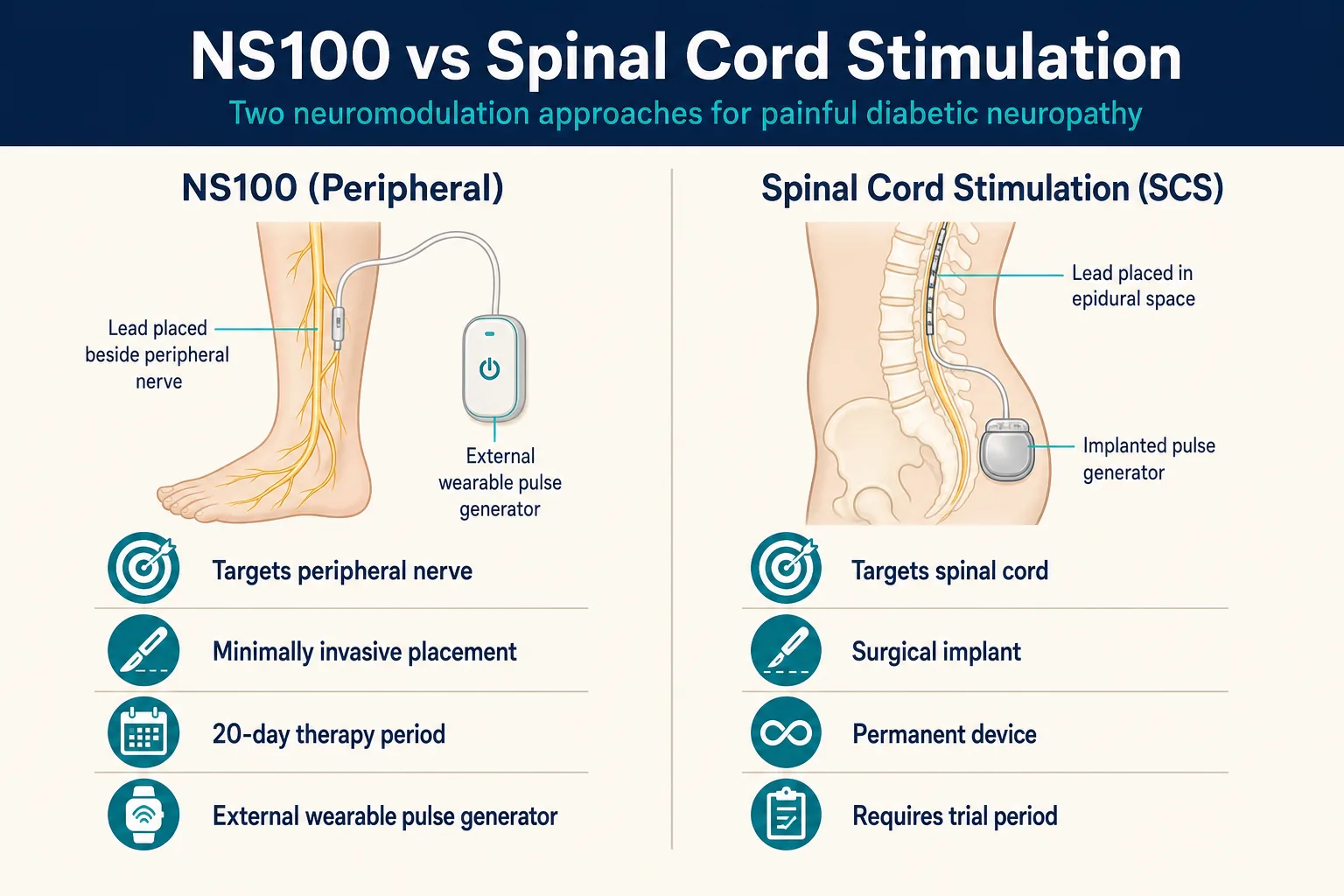
- Peripheral Nerve Stimulation (PNS), the technology used by the NS100 system, targets the specific peripheral nerves in the exact area where you feel pain, such as the nerves in your foot or lower leg.
- Spinal Cord Stimulation (SCS) targets the spinal cord itself, which acts as a major highway for all signals, including pain signals, traveling from the lower body to the brain.
Both aim to achieve pain relief, but their route to achieving it is fundamentally different. This difference influences every aspect of the treatment experience, from the initial procedure to the long-term management.
Comparing the Procedures: Placement and Invasiveness
How the therapy is delivered is one of the most significant distinctions between the NS100 system and SCS. This involves the level of invasiveness, the type of procedure, and what is left in your body.
The NS100 System Procedure
The NS100 system is designed to be a minimally invasive therapy. The procedure to place the system is performed by a qualified healthcare provider. During the procedure, a topical anesthetic is used to numb the skin on your foot or leg. This ensures you remain comfortable.
Once the area is numb, your provider will insert one or more very thin, flexible wires, called leads, just under the surface of the skin. These leads are precisely placed near the peripheral nerves that are thought to be the source of your PDN pain. The leads are the only part of the system that goes inside your body.
These leads are then connected to a small, external device that you wear. This device generates the gentle stimulation. There are no major incisions, no general anesthesia, and no permanently implanted components like batteries or generators. The entire procedure is self-contained and focused directly on the painful area.
The Spinal Cord Stimulation (SCS) Procedure
Spinal cord stimulation is a more involved surgical process that is typically done in two stages: a trial stage and a permanent implantation stage.
The trial stage is a test to see if SCS will be effective for you. A provider uses a needle to place temporary leads into the epidural space near your spinal cord. These leads are connected to an external trial stimulator that you wear for several days to a week. During this time, you and your provider assess how much pain relief the stimulation provides.
If the trial is successful (meaning you experience a significant reduction in pain), you can then proceed to the second stage: permanent implantation. This is a surgical procedure. The temporary leads are removed and new, permanent leads are placed in the epidural space. Then, the surgeon makes an incision, usually in the buttock or abdominal area, to create a small pocket under the skin. An implantable pulse generator (IPG), which is a device similar to a pacemaker that contains the battery and electronics, is placed into this pocket. A wire is tunneled under the skin to connect the IPG to the leads in your back.
Duration of Therapy: A Temporary Treatment vs. a Permanent Implant
The timeline of your treatment is another critical difference. The NS100 system and SCS operate on completely different philosophies regarding treatment duration.
The NS100 Approach: Short-Term and Restorative
The NS100 therapy protocol is designed for a specific, finite duration. The system is worn for approximately 20 days. During this time, it delivers continuous stimulation to the affected peripheral nerves.
The goal of NS100 is not just to provide pain relief while the device is on, but to provide a restorative effect that leads to sustained, long-term pain relief even after the therapy is complete. Published clinical evidence supports the potential for lasting pain reduction following the treatment cycle. At the end of the approximately 20-day period, you return to your provider's office, and the leads are gently and easily removed. There is no ongoing device to manage or maintain.
The SCS Approach: Long-Term and Continuous
Spinal cord stimulation, by contrast, is a long-term, ongoing pain management solution. The implanted IPG and leads are intended to remain in your body permanently to provide continuous pain relief for years.
You control the stimulation using an external remote, allowing you to turn it on or off and adjust the intensity as needed based on your activity level and pain. While it is designed to be a permanent solution, it does require long-term maintenance. The battery inside the IPG has a limited lifespan, typically lasting several years. When the battery runs out, another surgical procedure is required to replace the IPG unit. SCS is a commitment to a lifelong partnership with an implanted medical device.
Recovery, Reversibility, and Daily Life
Your day-to-day experience during and after the therapy differs significantly between the two options.
Daily Life and Reversibility with NS100
Because the NS100 placement is minimally invasive, the recovery is typically simple. You will have a small external device and dressings to manage for the approximately 20-day treatment period. Your provider will give you instructions on how to care for the site and may recommend certain activity modifications, particularly regarding showering and keeping the area dry. Once the leads are removed at the end of the therapy, these minor restrictions are lifted, and you can return to all normal activities. There are no permanent limitations.
A key feature of the NS100 system is its complete reversibility. At the end of the treatment course, the system is fully removed, leaving nothing behind. This means that if your pain were to change or return in the future, you retain all of your future treatment options, including the possibility of repeating the NS100 therapy or exploring other avenues with your provider.
Daily Life and Reversibility with SCS
Recovery after permanent SCS implantation surgery is more involved. It requires healing from the surgical incisions in your back and the IPG pocket. Your provider will give you specific post-operative restrictions, which often include limiting bending, lifting, and twisting for several weeks to allow the leads to anchor properly and prevent them from moving.
Living with a permanent SCS implant becomes a new normal. You will need to be mindful of the device. For example, you will carry a patient ID card for airport security and must inform other medical professionals about your implant, as it can affect procedures like MRI scans (though most modern SCS systems are MRI-conditional). While the SCS system can be surgically removed if it is no longer effective or causes issues, this is another invasive procedure and is not as simple as the initial implantation.
Finding the Right Fit: Who is a Candidate?
Determining candidacy for either therapy is a decision made between you and a qualified healthcare provider after a thorough evaluation. However, there are some general profiles that might steer the conversation one way or another.
Potential candidates for the NS100 system often include:
- Patients with PDN pain that is localized to a specific area, such as the feet or lower legs, where peripheral nerves can be directly targeted.
- Individuals who prefer a minimally invasive approach and are hesitant about a permanent surgical implant.
- Patients interested in a short-term, restorative treatment with the goal of lasting relief without a lifelong device.
Potential candidates for SCS often include:
- Patients with chronic, severe pain that is more widespread.
- Individuals who have had a successful SCS trial and are comfortable with the idea of a permanent surgical implant and its long-term management requirements.
- Patients who are looking for an on-demand, continuous pain management solution they can control for years to come.
Key Questions to Ask Your Healthcare Provider
Your journey to better pain management starts with a conversation. The goal is shared decision-making, where your preferences and goals are just as important as the clinical facts. Here are some questions to help guide your discussion:
- Based on my specific pain pattern and health history, do you believe I am a better candidate for peripheral nerve stimulation like NS100 or for spinal cord stimulation?
- Could you explain the potential benefits and risks of each therapy as they apply to me personally?
- What does the published clinical evidence suggest about the long-term success rates for each of these treatments for patients like me?
- Please walk me through the entire process for each option, from the first step to the last, including recovery and any long-term lifestyle changes.
- What are the general considerations regarding insurance coverage for these different types of therapies?
Choosing a path for managing your painful diabetic neuropathy is a significant decision. Both the NS100 system and spinal cord stimulation represent major advances in pain medicine, offering hope beyond the pharmacy counter. There is no single best answer — only the answer that is best for you. It depends on your unique pain, your health, your lifestyle, and your personal treatment goals. The most important step is to have an open conversation with your healthcare provider to explore all your options.
To learn more about the NS100 system as a non-opioid therapy for painful diabetic neuropathy, contact NeuroDynamics Global to learn more.
Important medical disclaimer. This content is for general informational and educational purposes only and is not medical advice, diagnosis, or treatment. It does not establish a physician–patient relationship. Always consult a qualified healthcare provider before starting, stopping, or changing any medication or therapy.
About NS100 by NeuroDynamics Global. NS100 is an FDA-cleared Class II peripheral nerve stimulation medical device for chronic pain associated with painful diabetic neuropathy. Use of NS100 requires evaluation and prescription by a qualified healthcare provider. As with any medical device, NS100 carries potential risks; your provider will review indications, contraindications, and possible side effects with you.
Results vary. Individual results and experiences vary from patient to patient. No specific outcome is guaranteed. Coverage and reimbursement are payer- and plan-specific.
Want to learn more?
Talk to your healthcare provider or contact NeuroDynamics Global today.