The 20-Day NS100 Treatment Journey: What Patients Can Expect
In brief
Embarking on the NS100 treatment journey for PDN? Learn what to expect, from the initial consultation and minimally invasive placement to the approximately 20-day therapy period and beyond.
Living with painful diabetic neuropathy (PDN) can feel like a constant battle against burning, tingling, and sharp, stabbing pains in your feet and legs. Finding a treatment that provides lasting relief without relying on daily medications can be a challenge. The NS100 system by NeuroDynamics Global offers a different approach: a short-term, minimally invasive therapy designed to provide long-term relief from chronic nerve pain.
If you and your healthcare provider are considering this option, you likely have many questions about what the process entails. This article serves as your guide to the NS100 treatment journey.
Step 1: The Initial Consultation and Candidacy Screening
The NS100 treatment journey begins not with a procedure, but with a conversation. The initial consultation is a critical first step where you and your healthcare provider will discuss your experience with painful diabetic neuropathy and determine if the NS100 system is a suitable option for you.
During this appointment, your provider will want to understand your medical history in detail. Be prepared to discuss:
- The specific symptoms you experience, such as burning, tingling, or shooting pains.
- How long you have been living with these symptoms.
- The severity of your pain and how it impacts your daily activities, sleep, and overall quality of life.
- Any previous treatments you have tried and how effective they were.
- Your overall health, including the management of your diabetes and any other medical conditions.
Your provider will also conduct a physical examination, focusing on the areas affected by your neuropathy. This may involve checking your reflexes, sensation, and circulation in your feet and lower legs.
This appointment is your opportunity to ask questions. The ideal candidate is typically someone who has not found adequate relief from more conservative treatments and is seeking a non-opioid solution for their chronic nerve pain.
Step 2: The Minimally Invasive Placement Procedure
Once you and your provider have decided to move forward, the next step is the placement of the NS100 system. This is a minimally invasive procedure performed right in your provider's office. Unlike major surgery, it does not require general anesthesia or a hospital stay.
Preparation First, the healthcare provider will identify the precise area on your leg or foot where the therapy will be most effective. The skin will be thoroughly cleaned and prepped to ensure a sterile environment.
Anesthesia To ensure your comfort, a topical anesthetic will be applied to numb the skin at the insertion site. You will be awake and aware during the procedure, but should feel little to no discomfort.
Lead Placement Using a small, specialized tool, the provider will place a very thin, flexible wire, called a lead, just beneath the surface of your skin. The lead is positioned near the specific peripheral nerves that are transmitting the pain signals.
Connecting the System The end of the lead that remains outside the body is securely taped to your skin and connected to a small, wearable external pulse generator about the size of a small keychain remote.
The entire placement procedure is typically completed in under 30 minutes. You will be able to go home the same day.
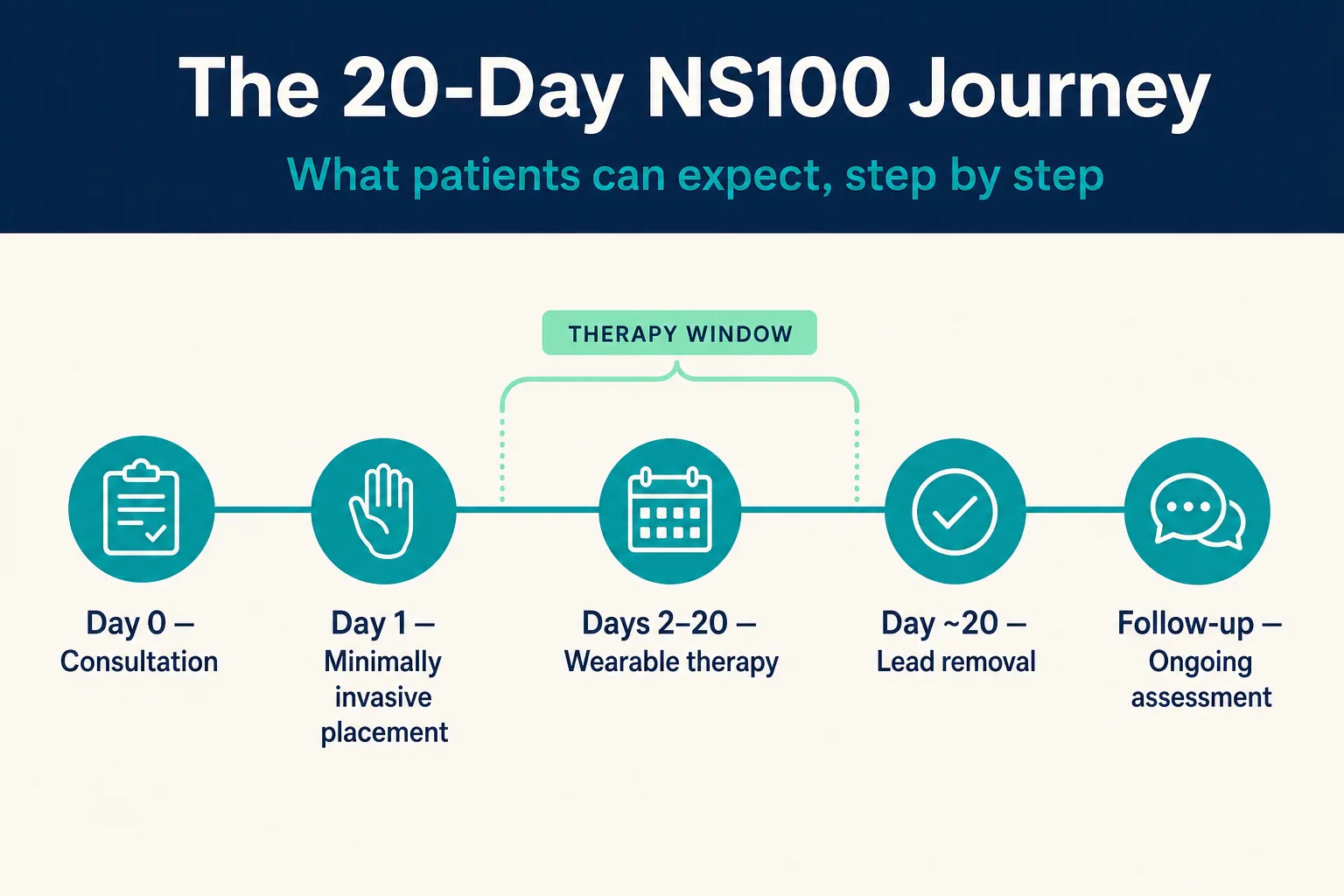
Step 3: Life During the Stimulation Period (Approximately 20 Days)
With the NS100 system in place, you will begin the active therapy phase, which lasts for approximately 20 days. The goal of this stimulation is to interrupt or block the pain signals before they can reach your brain.
What Does Stimulation Feel Like? Most patients experience a gentle tingling, buzzing, or pulsing in the treatment area. The sensation should be comfortable and never painful. Your healthcare provider will adjust the intensity to a level that is both effective and comfortable.
Daily Activities and Device Care The NS100 system is designed to have a minimal impact on your day-to-day life. The external pulse generator can be discreetly clipped to your clothing or placed in a pocket. You can continue with most normal daily activities. However:
- Keep the Area Dry: The external components are not waterproof. Take care to keep the insertion site and the pulse generator dry when bathing.
- Avoid Strenuous Activity: Avoid high-impact activities like running. Gentle walking and light activity are generally fine.
- Monitor the Site: Check the insertion site daily for any signs of redness or irritation.
Throughout the approximately 20-day period, you will be in communication with your healthcare team for check-ins and adjustments.
Step 4: Simple Removal of the System
After the approximately 20-day treatment cycle is complete, the next step is the removal of the device. The removal process is even quicker and simpler than the placement.
You will return to your provider's office for this short appointment. The provider will carefully remove the tape securing the lead and then gently slide the thin lead out from under your skin. Most patients report feeling only a slight pulling sensation. There are no stitches to remove and no lengthy recovery period.
Step 5: After the Journey — Long-Term Follow-Up
The primary goal of the NS100 system is to provide lasting pain relief that continues long after the device has been removed. The approximately 20-day stimulation period is designed to modulate the function of the targeted nerves, providing a durable therapeutic effect.
In the weeks and months following the removal, you will have follow-up appointments with your healthcare provider. Published clinical evidence on this type of peripheral nerve stimulation has shown that many patients experience a significant and sustained reduction in their chronic PDN pain. It is important to have realistic expectations, as individual results can vary.
A Safe, Non-Opioid Approach
Patient safety is paramount. The NS100 system offers a favorable safety profile, primarily because it is a minimally invasive and temporary therapy. As a non-opioid treatment, NS100 provides a way to manage chronic pain without the risks associated with long-term opioid use.
The most common potential side effect is minor skin irritation at the lead insertion site, which typically resolves quickly after removal. Your healthcare provider will discuss all potential risks and benefits with you.
Is the NS100 Treatment Journey Right for You?
The NS100 treatment journey offers a structured, time-limited, and minimally invasive option with the potential for long-term relief from PDN. From the initial conversation to the supported 20-day therapy period and the straightforward removal, the process is designed to be clear and manageable.
Talk to your healthcare provider to see if the NS100 therapy is right for you, or contact NeuroDynamics Global to learn more.
Important medical disclaimer. This content is for general informational and educational purposes only and is not medical advice, diagnosis, or treatment. It does not establish a physician–patient relationship. Always consult a qualified healthcare provider before starting, stopping, or changing any medication or therapy.
About NS100 by NeuroDynamics Global. NS100 is an FDA-cleared Class II peripheral nerve stimulation medical device for chronic pain associated with painful diabetic neuropathy. Use of NS100 requires evaluation and prescription by a qualified healthcare provider. As with any medical device, NS100 carries potential risks; your provider will review indications, contraindications, and possible side effects with you.
Results vary. Individual results and experiences vary from patient to patient. No specific outcome is guaranteed. Coverage and reimbursement are payer- and plan-specific.
Want to learn more?
Talk to your healthcare provider or contact NeuroDynamics Global today.