Is Neuropathy Treatment Covered by Medicare or Insurance?
In brief
Coverage for diabetic neuropathy treatment depends on your specific plan, your diagnosis, and your treatment history. Here is how Medicare and commercial insurance generally approach coverage — and how to find out what your plan will pay.
The short answer
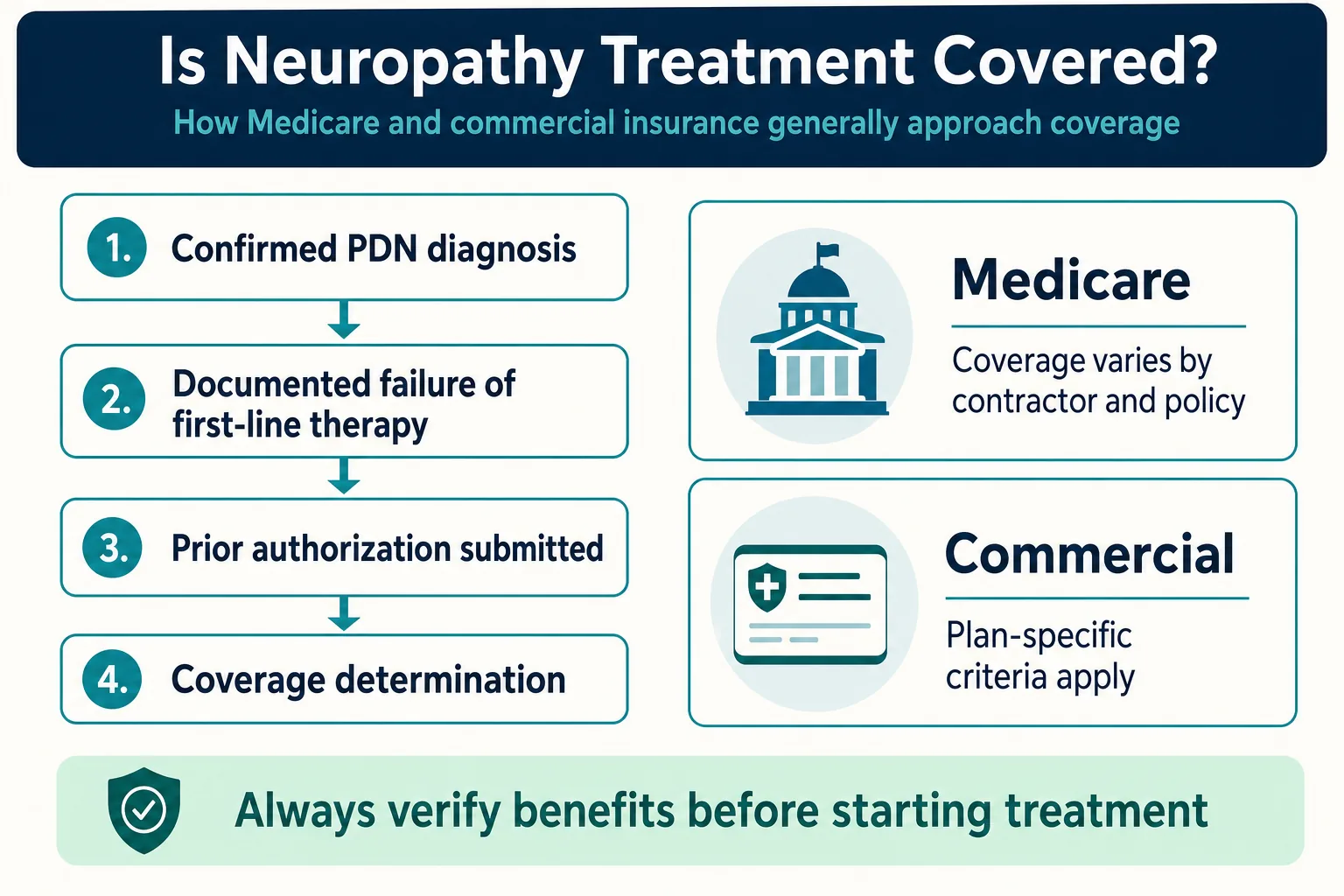
Coverage for treatments for painful diabetic neuropathy is payer- and patient-specific. Most medications used for diabetic nerve pain are covered by Medicare Part D and most commercial drug plans. Procedures and devices — including peripheral nerve stimulation (PNS) and spinal cord stimulation (SCS) — are typically subject to prior authorization and require documentation of medical necessity.
Below is a practical guide to what to expect and how to get an answer before treatment begins.
What insurance typically covers
Medications
Most first-line oral medications for painful diabetic neuropathy (gabapentin, pregabalin, duloxetine) are covered under prescription drug benefits. Specific copays, tier placement, and step-therapy requirements vary by plan.
Procedures and devices
Neuromodulation procedures such as PNS and SCS are usually evaluated case by case. Payers typically expect documentation of:
- A confirmed diagnosis of chronic pain associated with painful diabetic neuropathy
- A trial of conservative treatments, including first-line medications where appropriate
- Clinical notes explaining why the proposed therapy is medically necessary
The prior authorization process
For neuromodulation specifically, the steps generally look like this:
- **Benefits investigation.** Your provider's office submits an inquiry to your insurer to confirm what is and is not covered.
- **Prior authorization request.** The treating practice submits a clinical packet documenting diagnosis, prior treatments, and medical necessity.
- **Determination.** The payer issues an approval, a denial, or a request for additional information.
- **Appeals (if needed).** Denials are common on first submission and are often reversible with a well-prepared appeal.
NeuroDynamics Global supports practices through this process with standardized templates and clinical evidence summaries. For a step-by-step walkthrough, see our [insurance coverage page](/insurance-coverage).
What to ask your insurer
If you want to call your plan directly, useful questions include:
- Is peripheral nerve stimulation a covered benefit under my plan?
- Does the procedure require prior authorization?
- What documentation does the prior-authorization request need to include?
- What is my deductible, and how much have I met this year?
- What is my expected coinsurance or copay for this type of procedure?
- Who is in-network for this treatment in my area?
What about Medicare?
Medicare beneficiaries should expect similar prior-authorization requirements, with details set by their specific plan (Original Medicare with a supplement, Medicare Advantage, or Part D for medications). Coverage decisions are payer-specific; your treating practice and our reimbursement team can help you understand what your particular plan requires.
How to keep out-of-pocket cost predictable
The right time to learn the cost of treatment is before you start, not after. Before the 20-day NS100 protocol begins, your treating practice should provide:
- A written benefits summary, including expected deductible, coinsurance, and copay
- Confirmation that prior authorization has been obtained where required
- A clear plan for what happens if your insurer denies coverage
NeuroDynamics Global does not charge surprise fees outside of what is communicated up front.
Bottom line
Insurance coverage for painful diabetic neuropathy treatment is real but rarely automatic. Asking the right questions early, working with a treating practice that handles prior authorization confidently, and getting a written cost estimate before treatment starts are the practical steps that prevent most coverage surprises.
For a complete coverage walkthrough, visit our [insurance coverage page](/insurance-coverage). To explore whether you may be a candidate for NS100 neuromodulation therapy, take our [educational candidate screener](/am-i-a-candidate) or learn more about the [NS100 therapy](/ns100).
This article is educational and is not medical, legal, or financial advice. Coverage is payer- and patient-specific.
Important medical disclaimer. This content is for general informational and educational purposes only and is not medical advice, diagnosis, or treatment. It does not establish a physician–patient relationship. Always consult a qualified healthcare provider before starting, stopping, or changing any medication or therapy.
About NS100 by NeuroDynamics Global. NS100 is an FDA-cleared Class II peripheral nerve stimulation medical device for chronic pain associated with painful diabetic neuropathy. Use of NS100 requires evaluation and prescription by a qualified healthcare provider. As with any medical device, NS100 carries potential risks; your provider will review indications, contraindications, and possible side effects with you.
Results vary. Individual results and experiences vary from patient to patient. No specific outcome is guaranteed. Coverage and reimbursement are payer- and plan-specific.
Want to learn more?
Talk to your healthcare provider or contact NeuroDynamics Global today.