Technical summaries of clinical evidence for the NS100 nerve stimulator in painful diabetic neuropathy — designed for physicians, pain specialists, endocrinologists, and clinical researchers evaluating peripheral nerve stimulation therapy.
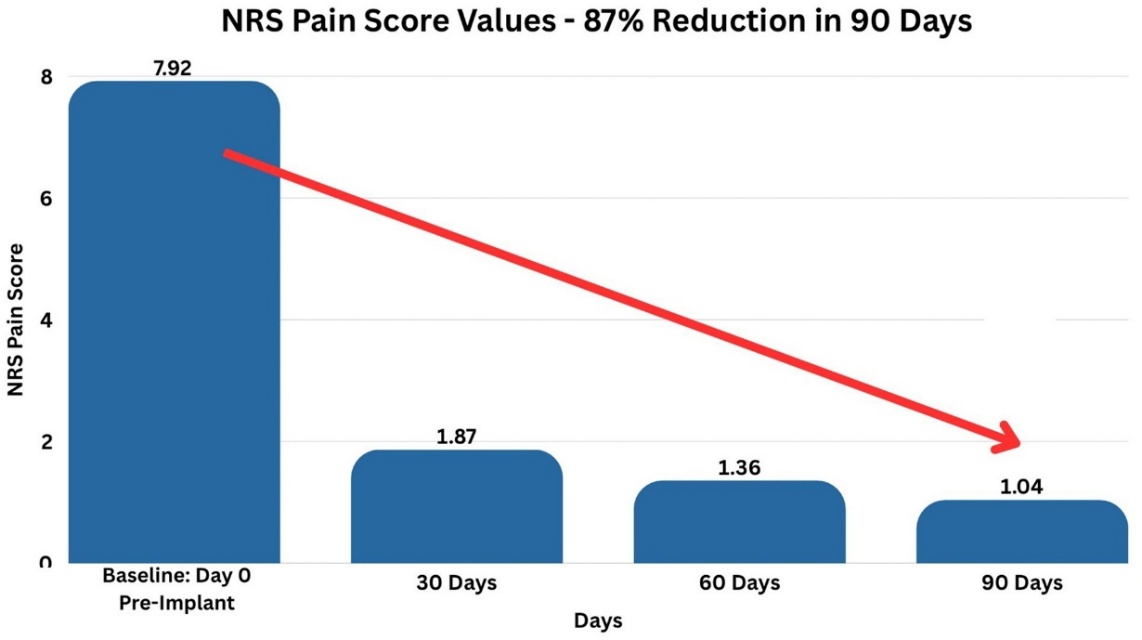
87%
NRS pain reduction at 90 days
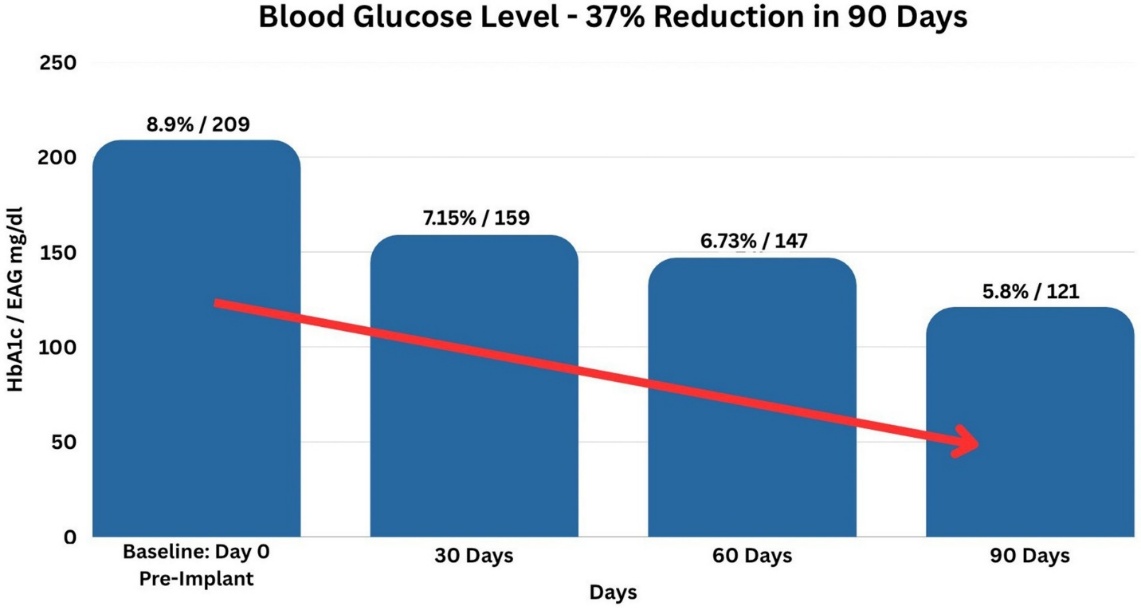
37%
Mean fasting glucose reduction
7.85 mo
Duration of effect maintained
Published
Combined Minimally Invasive Vagal Cranial Nerve and Trigeminocervical Complex Peripheral Nerve Stimulation in Type 2 Diabetes with Painful Peripheral Neuropathy
Staats P. S., Staats A., Mikhaiel B., Chen J., Azabou E., Rangon C.-M.
Frontiers in Neuroscience, vol. 19, article 1644961 (August 2025)
Design
Prospective observational analysis of consecutive patients treated with the NS100 nerve stimulator under a standardized 20-day percutaneous protocol; mean follow-up 227 days.
Population
83 adults with type 2 diabetes and moderate-to-severe painful peripheral neuropathy refractory to conservative therapy. Subset analysis on 45 patients with complete medication records.
Intervention
Minimally invasive percutaneous peripheral nerve stimulation targeting vagal cranial nerve and trigeminocervical complex pathways via the NS100 device.
Endpoints
Numerical Rating Scale (NRS) pain score change at 90 days and at last follow-up
Mean fasting blood glucose (mg/dL) change at 90 days and at last follow-up
Discontinuation of pain and diabetes medications (subset n = 45)
Duration of effect (months maintained)
Results
Mean NRS pain score decreased from 7.92 to 1.04 within 90 days — an 87% reduction.
Mean fasting glucose normalized from 209 mg/dL to 121 mg/dL within 90 days — a 37% reduction.
Both endpoints were maintained for an average of 7.85 months post-treatment.
Conclusion
Combined vagal and trigeminocervical peripheral nerve stimulation delivered through the NS100 protocol produced prolonged, statistically significant improvement in both painful peripheral neuropathy and glycemic control in type 2 diabetes patients, supporting further controlled investigation.
Individual results vary. Study findings are not a guarantee of outcome.
Figure 1 — NRS pain score trajectory (Staats et al., 2025).Figure 2 — Mean fasting blood glucose trajectory (Staats et al., 2025).
Staats, P. S., Staats, A., Mikhaiel, B., Chen, J., Azabou, E., & Rangon, C.-M. (2025). Frontiers in Neuroscience, 19, 1644961. doi:10.3389/fnins.2025.1644961
Double-Blind, Randomized, Placebo-Controlled Trial of Peripheral Neurostimulation in Painful Diabetic Peripheral Neuropathy
Madhuchander S., Gurunath S.
North American Neuromodulation Society (NANS) Annual Meeting, January 2019
Design
Double-blind, randomized, placebo-controlled trial comparing active fixed and sweep-frequency neurostimulation against sham stimulation.
Population
89 adults with peripheral neuropathy secondary to type 2 diabetes mellitus.
Intervention
Peripheral electrical nerve stimulation delivered at fixed and swept frequencies versus matched sham stimulation.
Endpoints
Visual Analog Scale (VAS) for pain
Vibration Perception Threshold (VPT) for sensory nerve function
Overall Neuropathy Limitations Scale (ONLS) for patient function
Anxiety and sleep quality scales
Results
68.25% of subjects receiving active stimulation showed clinically significant pain reduction on VAS.
Statistically significant improvement in VPT, ONLS, anxiety, and sleep scores in active arms (p < .001).
Effects were reproducible across fixed and sweep-frequency arms and were not observed in the sham group, supporting direct attribution to the neurostimulation intervention.
Conclusion
Active peripheral neurostimulation produced statistically significant, reproducible improvements in pain, sensory function, daily function, and quality-of-life measures versus placebo in painful diabetic neuropathy.
Individual results vary. Study findings are not a guarantee of outcome.
Recruiting
Multi-Center, Prospective, Open-Label, Observational Study of NS100 Percutaneous Peripheral Nerve Stimulation in Painful Diabetic Neuropathy with Continuous Glucose Monitoring
Cleveland Clinic (National Principal Investigator) and Partner Sites
Active multi-site clinical study — currently recruiting
Design
Approximately 6-month, multi-center, prospective, open-label observational study with ~9 scheduled study visits and continuous glucose monitoring throughout.
Population
Approximately 50 adults with type 1 or type 2 diabetes and moderate-to-severe painful diabetic neuropathy.
Intervention
Percutaneous implantation and 20-day stimulation protocol with the NS100 nerve stimulator.
Endpoints
Reduction in diabetic neuropathic pain (NRS)
Continuous glucose monitoring metrics over the study period
Safety and tolerability of percutaneous NS100 placement
Results
Enrollment ongoing; outcome data not yet available.
Conclusion
Designed to characterize the durability of pain relief and the concurrent metabolic effects of the NS100 protocol in a real-world multi-center setting.
Individual results vary. Study findings are not a guarantee of outcome.
High-Frequency (10-kHz) Spinal Cord Stimulation in Patients With Painful Diabetic Neuropathy (SENZA-PDN)
Petersen E. A., et al.
JAMA Neurology, 2021
Design
Prospective, multi-center, randomized clinical trial comparing 10-kHz spinal cord stimulation plus conventional medical management to conventional medical management alone.
Population
216 adults with lower-limb pain due to painful diabetic neuropathy refractory to standard pharmacologic therapy (gabapentinoids, SNRIs, TCAs, topical and analgesic agents).
Intervention
High-frequency (10-kHz) spinal cord stimulation, evaluated against conventional medical management as the comparator arm.
Endpoints
≥50% pain relief without worsening neurologic deficits (responder rate)
Change in neuropathy-related quality-of-life measures
Safety and tolerability over 6 months
Results
79% responder rate in the high-frequency SCS arm versus 5% in the medical-management-only arm.
Significant improvements in pain, function, and quality of life favoring the neurostimulation arm.
Favorable safety and tolerability profile consistent with prior SCS literature.
Conclusion
Independent third-party Level 1 evidence supporting neurostimulation as a durable, drug-free pathway for painful diabetic neuropathy — reinforcing the rationale for the NS100 minimally invasive, peripheral-nerve approach used in the NeuroDynamics protocol.
Individual results vary. Study findings are not a guarantee of outcome.
Petersen E. A., et al. (2021). High-frequency 10-kHz spinal cord stimulation for painful diabetic neuropathy: SENZA-PDN randomized clinical trial. JAMA Neurology.